Google’s AI Overviews have been rolling out across search results since mid-2024. By now, if you search almost any informational query, there’s a reasonable chance the top of the results page is a generated summary, not a list of blue links.
That’s a real shift. And it’s worth understanding before you decide whether to worry about it or work with it.
What AI Overviews Actually Are
When Google shows an AI Overview, it’s generating a synthesized answer at the top of the results page, usually with citations linking to specific pages it pulled from. Think of it less like a featured snippet and more like a mini research summary, assembled in real time from sources Google considers credible and relevant.
The pages that get cited are the sources. The pages that don’t get cited are invisible, at least in that slot.
For search terms where an AI Overview appears, the traditional organic listings shift down. That’s where the traffic concern comes from. But the story is more complicated than “AI Overviews steal clicks.”
Who Actually Gets Cited
This is where it gets interesting for site owners. Google doesn’t pull citations at random. The pages that show up in AI Overviews share a few consistent characteristics.
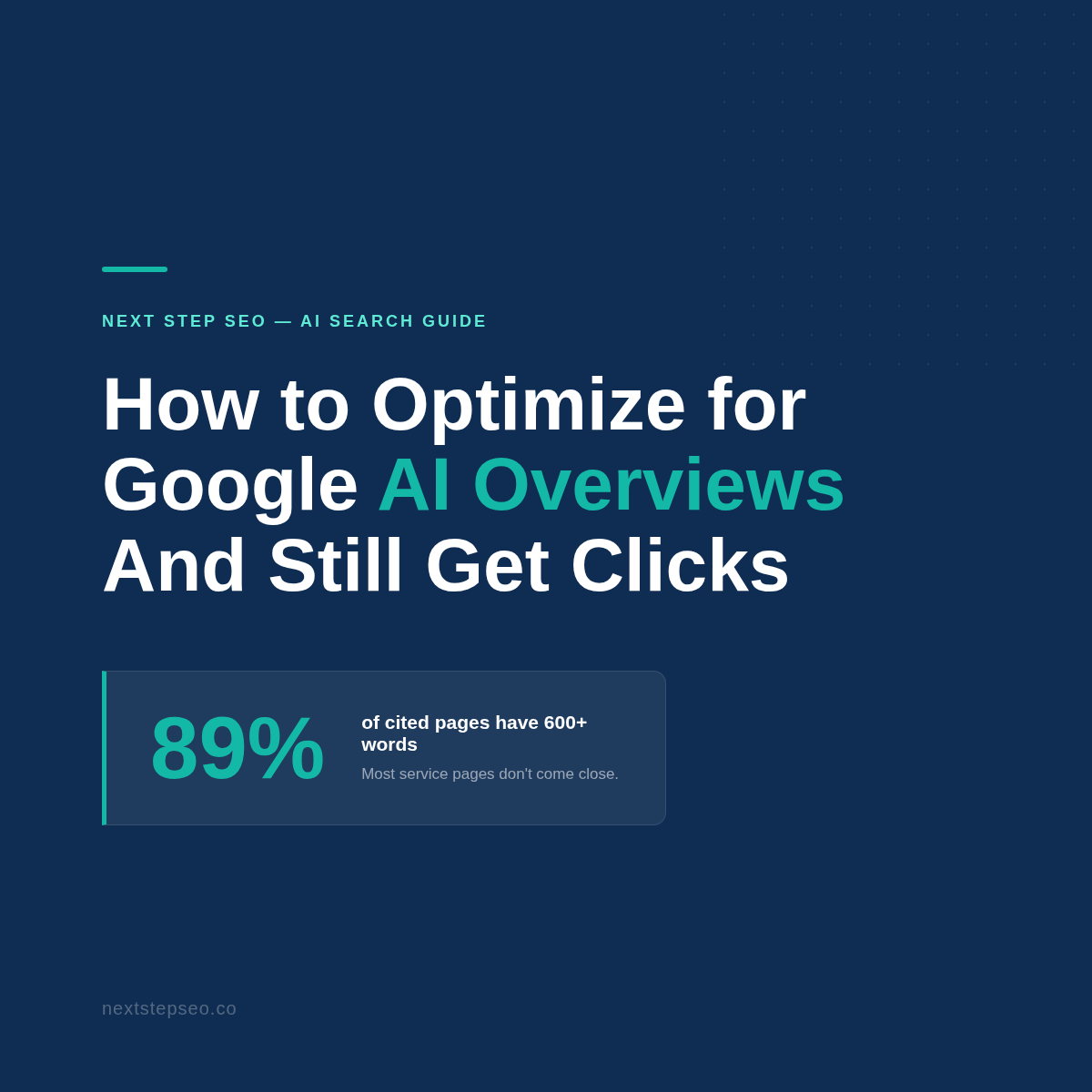
They’re substantive. A page with 200 words describing a service is not going to get cited in an AI-generated answer. Google needs enough text to extract a meaningful, quotable passage. Pages under 400 words almost never appear in AI Overview citations. The sweet spot is 600 to 1,000 words of relevant, focused content.

They’re structured. Pages with clear H2 and H3 headers, short introductory paragraphs under each section, and a logical flow from question to answer perform significantly better than walls of undifferentiated text. Google’s AI is essentially reading the page the way a careful reader would: skimming headers, then reading the sections that match the query.
They answer the question directly. The single biggest mistake we see on professional services sites is content that talks around a topic rather than at it. “We offer comprehensive consulting services tailored to your needs” does not answer the question someone just typed into Google. A page that explains what consulting actually involves, what the process looks like, and what outcomes clients should expect has a fighting chance of being cited. The vague one does not.
The FAQ Effect
One structural pattern that consistently surfaces in AI Overview citations is Q&A formatting. Pages that include a genuine FAQ section, or that use questions as H2 headers (“What does a technical SEO audit include?” rather than just “Technical SEO Audit”), get cited at a noticeably higher rate.

This isn’t a trick. It’s an alignment between what your audience is asking and how you’ve organized your answer. If someone types “how do I know if my site needs an SEO audit” and your page has a section with exactly that header, followed by a clear answer, you’ve built a citation-ready passage.
You don’t need to restructure your entire site. Pick your three highest-value pages, identify the three most common questions a new client would ask about each topic, and add those as explicit headers with direct answers under each one. That alone meaningfully increases your chances of appearing in an AI Overview for the queries that matter most to your business.
About the Traffic Question
Whether AI Overviews hurt click-through rates depends heavily on the query type. For pure informational queries (“what is a canonical tag”), click-through rates drop significantly when an AI Overview appears. The answer is right there. People don’t need to click.

For commercial and transactional queries (“best SEO agency for law firms”), the picture is different. People researching a purchase or a service are more likely to click through to evaluate their options, even when a summary is present. The AI Overview creates awareness of which sources it cited, and that drives a different kind of traffic: users who already have some context about what you do and are now deciding whether to learn more.
The practical takeaway is to be deliberate about which queries you target. Don’t spend optimization effort on purely informational queries where the click has low conversion value. Focus on queries where being cited builds credibility and puts your brand in front of someone early in a buying decision.
What Schema Markup Actually Does Here
Schema markup is not a magic solution for AI Overview visibility. But it does two things worth understanding.

First, it helps Google categorize your page accurately. If your firm answers a specific type of question and your page is marked up with FAQPage or HowTo schema, Google has one less thing to infer. That reduces ambiguity and increases the likelihood your content gets matched to the right query.
Second, it signals that someone built this page with care. That’s not an algorithm signal in any formal sense, but the sites that use structured data tend to be the same sites that write real answers to real questions. The markup and the content quality tend to come together.
Where to Start
If you want to know whether your site is in a position to compete for AI Overview citations, start with a crawl. Export your top service and resource pages, check word counts and heading structure, and look honestly at whether each page answers a specific question or just describes your offerings in general terms.

The gap, when you find it, is almost always the same. The page was written as a brochure. It needs to work as an answer.
That’s not a small project, but it’s a tractable one. A handful of well-structured pages will consistently outperform a large inventory of thin ones when it comes to AI search visibility. The sites that get this right in the next 12 months will have a real structural advantage, because most of their competitors haven’t touched their service pages since the site launched.
If you want to see where your site stands before you start rewriting anything, we map this out specifically in our technical audits. No guesswork, no generic recommendations.