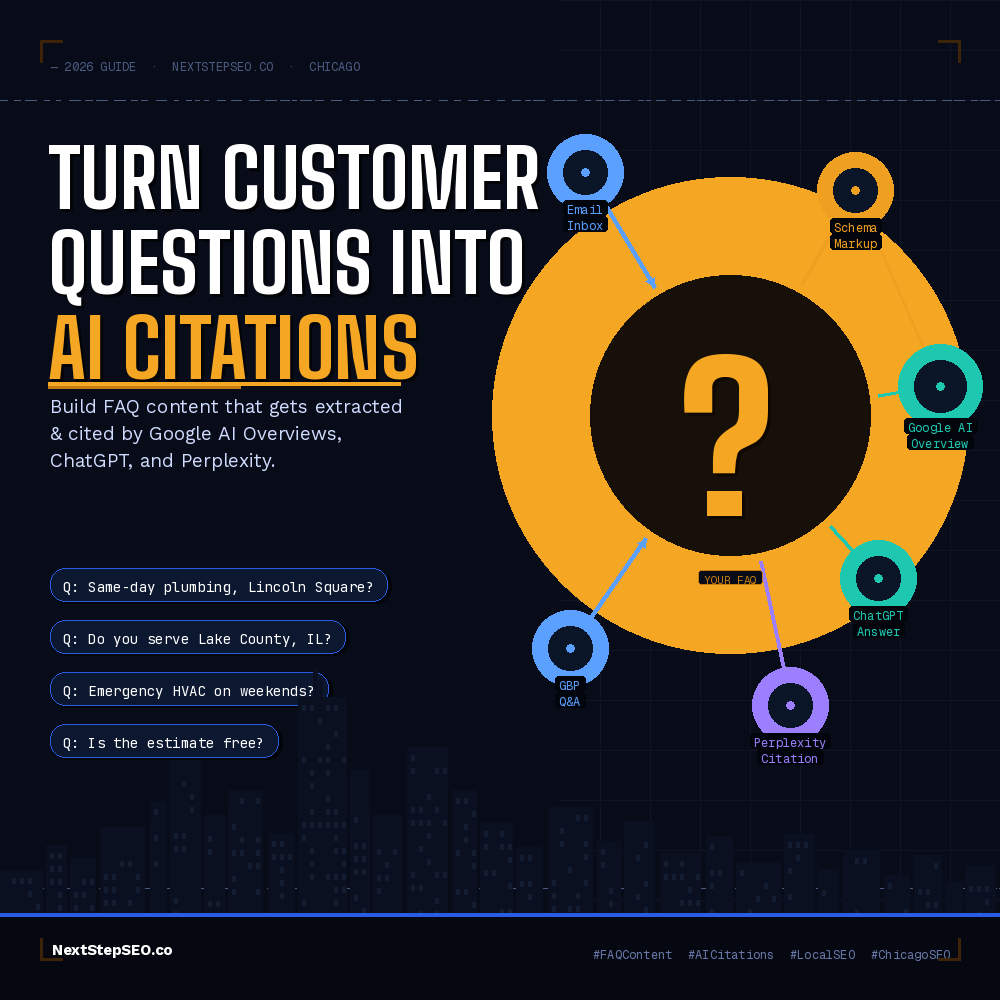
If you run a service business in the Chicago area, your customers are already asking AI tools questions about your industry — and right now, someone else is getting cited as the answer. Building FAQ content for AI citations is the most direct way to change that. Instead of waiting to rank in traditional search results, a properly structured FAQ page puts your business name inside the AI-generated summaries that millions of people read before they ever click a link.
This guide walks Chicago-area small business owners through the exact process: no developer needed, no technical background required. You’ll learn how to collect real customer questions, write answers that AI systems extract, and structure a page that Google AI Overviews, ChatGPT, and Perplexity actually cite.
Quick stat: Structured content — headings, lists, and FAQ format — is the most effective content type in AI search, and 44.2% of all AI citations come from the first third of an article. That’s why this introduction matters as much as the steps below.
Why FAQ Content Drives AI Citations in 2026
The Way Chicago Customers Search Has Shifted
Chicagoans stopped typing “plumber near me.” Today they ask, “Is there a licensed plumber available same-day in Lincoln Square?” That shift toward full, conversational questions has been building for years — but AI search tools like Google’s AI Overviews and ChatGPT accelerated it completely. These systems don’t rank ten blue links. They read a question, scan indexed content for the clearest, most trustworthy answer, and synthesize a response that credits its source.
For local service businesses, that shift is an opening, not a threat.
AI Systems Are Designed to Extract Question-Answer Pairs
Here’s what matters about how these tools work: AI citation engines scan specifically for question-and-answer structures. A literal question phrased the way a real customer would ask it, followed by a direct, factual, concise answer — that’s the pattern they’re built to find and pull. When that pattern appears alongside proper semantic markup, the likelihood of extraction increases significantly.
What they skip: keyword-stuffed paragraphs, vague “About Us” copy, and service descriptions that circle a topic without ever answering a specific question.
Your Inbox Already Contains the Raw Material
Most Chicago small businesses are sitting on the best FAQ content they’ll ever write — they just haven’t formatted it yet. The questions inside your email inbox, voicemail, Google Business Profile Q&A, and last week’s customer calls are nearly identical to the questions AI tools are fielding right now. When you turn those into structured FAQ content for AI citations, you’re not guessing at what people want to know. You’re answering questions your actual customers are already asking, in the exact phrasing they use.
How to Build FAQ Content for AI Citations: Step-by-Step
No coding required. This is a straightforward content workflow any business owner can complete in an afternoon.
Step 1: Collect Your Top 20 Real Customer Questions
Before writing a single word, gather raw material from your actual customers — not a keyword tool.
Where to look:
- Your email inbox and support tickets. Scan the past 90 days for questions that repeat. Three customers asking about weekend availability last month means that question belongs on your FAQ page.
- Phone logs and CRM notes. Ask your team to note the questions they field most often. Patterns matter more than word-for-word transcripts.
- Google Business Profile Q&A. Open your GBP dashboard and check what people have actually asked — including questions that went unanswered. Each gap is a content opportunity.
- Onboarding and consultation calls. What do new clients always want to know before they commit? Those questions reflect real purchase-stage uncertainty, which is exactly what AI tools are designed to resolve.
- Review responses. Reviews that mention confusion or ask follow-up questions are FAQ opportunities hiding in plain sight.
Once you have a list, aim for 20 questions and group them by theme: services, pricing, scheduling, location, and policies. That structure will guide how you organize the page.
Step 2: Write Answers AI Systems Can Extract
This is where most DIY FAQ content misses. Answers that are too short feel dismissive; answers that run 400 words of meandering prose never get pulled. The sweet spot is specific, direct, and skimmable.
How to Format Each FAQ Entry
Use the question as your H3 heading — phrased exactly as a real customer would ask it, not cleaned up into marketing language. Specificity is the point.
Write your answer in 100–200 words. Lead with the direct answer in sentence one. Add supporting context in sentences two and three: what happens next, what exceptions apply, what the customer should do. Close with a clear action step when relevant.
Use 3–5 bullet points when describing a process, listing options, or outlining what’s included. AI systems extract structured lists reliably.
Add one or two internal links to relevant service pages or blog posts to reinforce topical authority.
Before and After: What a Citable Answer Looks Like
Before (vague, non-extractable): “We try to accommodate same-day requests whenever possible depending on our current schedule and technician availability.”
After (direct, extractable):
How do I book same-day plumbing service in Mundelein?
Call our scheduling line before 2:00 PM CST and we’ll check technician availability in real time — confirmations typically come within 15 minutes. Our dispatch hub is in Libertyville, putting us about 20 minutes from most Mundelein neighborhoods. Non-emergency same-day slots are usually available through early afternoon. After-hours emergency calls carry a higher rate, which we quote before any work begins. Book online or call us directly to get started. [See our full Mundelein service area →]
The second version answers the question, specifies the location, gives a real timeframe, addresses cost proactively, and provides a next step. That’s what AI citations are made of.
Step 3: Structure Your Page for Maximum Extractability
How the page is organized matters as much as what it says. A disorganized FAQ page with excellent content still gets skipped if AI systems can’t parse it efficiently.
Use a Dedicated FAQ Page
A standalone page with its own URL signals topical focus and is easier to index as a coherent resource. FAQs scattered across the footer of a service page carry significantly less weight.
Add FAQ Schema Markup
This is the one technical step in this guide — and it’s more accessible than it sounds. On WordPress, plugins like Rank Math, Yoast SEO Premium, and Schema Pro apply FAQ schema automatically when you use their FAQ block. On Squarespace and Wix, built-in structured data tools handle most of it. Schema markup explicitly signals to search engines that this content is a question-answer pair, which directly improves the probability of appearing in rich results and being extracted for AI citations. Google’s own documentation confirms FAQ schema as a supported format for rich results.
Organize With a Table of Contents
For pages with more than 10 entries, add a linked table of contents at the top and group questions by category: Services, Pricing, Scheduling, Coverage Area. Both users and crawlers benefit from clear section navigation.
Format for Mobile First
Google indexes your mobile content first — and so do AI crawlers. Keep paragraphs short. Bold key facts. Avoid horizontal scroll tables. If your FAQ page is difficult to read on a phone, it’s working against you.
What to avoid: walls of text, sales language inside answers, and keyword repetition that reads as stuffing. AI systems have become sophisticated enough to recognize when a “question” is really just a promotional claim in disguise.
Step 4: Connect FAQs to Your Topical Content Cluster
A well-built FAQ page is good. A FAQ page integrated into a network of related content is significantly more powerful.
Link FAQ Answers to Deeper Pages
Each answer should link to the most relevant service page or blog post on your site. Answering a question about your HVAC process? Link to your HVAC service page. Covering a pricing question? Link to your full pricing guide. This signals to search engines that your FAQ page is part of a coherent topical cluster — not an isolated orphan page. Topical authority accumulates over time, and the more your content interconnects around a theme, the more credible your site becomes as a source.
Link Back From Service Pages
Don’t forget bidirectional linking. Service pages and blog posts should reference the FAQ page when relevant. A natural link reads like: “For answers to the most common scheduling questions, visit our [FAQ page].” That loop reinforces the cluster from both directions.
Keep Internal Links Natural
Anchor text should describe what the linked page actually covers, not repeat a target keyword mechanically. Useful, honest links perform better than forced ones — for users and for search engines.
Step 5: Track Performance and Refresh Quarterly
Publishing the page is the start, not the finish. Businesses that consistently earn AI citations treat FAQ content as a living asset.
Monitor in Google Search Console
Google Search Console shows which question-phrased queries are generating impressions for your pages. Filter by query type to identify which FAQ entries are gaining traction and which are being skipped. Low click-through on a high-impression question usually means the answer needs to be sharpened or the title tag updated.
Track AI Overview Appearances
Tools like Semrush’s AI Overview tracker and Ahrefs now include features that flag when your content is cited in Google’s AI-generated answers. Set alerts for your business name and core service keywords. This is how you measure whether your FAQ content for AI citations is actually working.
Add New Questions Every 90 Days
Your customer base evolves — new services, new service areas, new pricing structures, and seasonal questions all generate new FAQ material. Build a quarterly habit of reviewing your inbox and call logs, asking yourself: “What have customers been confused about lately?” Add those questions before they become gaps.
Remove Outdated Content
An FAQ with stale pricing or discontinued services actively undermines credibility. Flag entries that need review on your quarterly pass and update or remove them promptly.
Real-World Example: What a Citable FAQ Entry Looks Like
Here’s a model FAQ entry for a Chicago-area home services business. The structure is what matters — adapt the content to your own industry and service area.
Do you offer emergency HVAC repair in Lake County on weekends?
Yes — emergency HVAC service is available throughout Lake County seven days a week, including holidays. Weekend calls placed before 6:00 PM are dispatched the same day. An on-call technician is available for after-hours emergencies and typically arrives within 90 minutes of your call. Emergency rates are higher than standard service rates; we quote the exact cost before beginning any work, so there are no surprises. To request emergency service, call our main line and press 2 for the emergency dispatch queue, or submit a request through our online portal. [View all Lake County service areas →]
That answer says yes immediately, names the location, gives a specific timeframe, addresses cost proactively, and closes with a clear action path. At 110 words, it’s extractable, credible, and genuinely useful to a homeowner in a stressful situation.
FAQ: Your Questions About FAQ Content for AI Citations
Should I use schema markup even if I’m not technical?
Yes — and it’s more manageable than it sounds. If your site runs on WordPress, Rank Math and Yoast handle FAQ schema automatically through their FAQ block. Most other major platforms have built-in structured data options. The payoff is real: FAQ schema markup improves your chances of appearing in rich results and being extracted by AI citation systems. It’s worth the 20 minutes to set up.
How many FAQ entries should go on one page?
A single FAQ page works well with 20 to 30 entries. Beyond that, consider splitting into focused sub-pages by topic — a pricing FAQ, a services FAQ, a coverage-area FAQ. Focused pages tend to outperform mega-pages for specific query types.
Do AI systems favor larger brands over small local businesses?
Not for specific local queries. A Chicago small business FAQ page that directly and clearly answers a neighborhood-specific question will regularly outperform a national brand’s vague service description. Hyper-local specificity is where small businesses compete on equal footing — and often win.
How long does it take to see results after publishing a structured FAQ page?
Most well-structured FAQ pages begin appearing in search impressions within one to two weeks of publication. AI Overview citations typically begin appearing within two to four weeks. Submit the page for indexing in Google Search Console to speed up the process.
Can I add FAQs to my homepage instead of a separate page?
You can, and it helps. A dedicated FAQ page still outperforms homepage FAQs because it signals topical depth and is easier for AI systems to process as a focused information resource. If you’re investing the time to build 20 quality entries, give them their own URL.
What if my business serves multiple Chicago suburbs?
That’s an advantage. Location-specific questions — “Do you serve Naperville?” or “Can you install in a condo in Evanston?” — are exactly the queries where local businesses regularly beat larger competitors in AI citations. Answer each location-specific question with the same precision you’d use in any other FAQ entry.
The Bottom Line
Building FAQ content for AI citations isn’t about stuffing a page with generic questions. It’s about converting the real, specific, repeated questions from your actual customers into structured, citable content that AI tools can find, extract, and credit — with your business name attached.
The businesses showing up in AI-generated answers right now aren’t always the biggest or the oldest. According to Search Engine Journal’s 2026 enterprise AI trend report, AI systems reward relevance, clarity, and authority — not just domain size. A Chicago HVAC company with 25 well-written, locally specific FAQ entries can outperform a national competitor’s generic service page on local queries.
Start with 10 questions pulled from your inbox. Build one clean, schema-marked FAQ page. Follow the structure in this guide. Then expand quarterly.
Your daily customer interactions are already generating the raw material. This process turns that material into a search asset that works around the clock.
Want help identifying your top FAQ gaps and building a content strategy around them? Our SEO Roadmap service starts with a full audit of your existing content and maps exactly what to build next. Reach out and let’s take a look.